Balancing the books or cooking them? A review of the First Tier Tribunal decision in Keighley & Anor [2024] TC 09023.
![Balancing the books or cooking them? A review of the First Tier Tribunal decision in Keighley & Anor [2024] TC 09023.](https://images.unsplash.com/photo-1553285991-4c74211f5097?crop=entropy&cs=tinysrgb&fit=max&fm=jpg&ixid=M3wxMTc3M3wwfDF8c2VhcmNofDEyfHxwZXR0eSUyMGNhc2h8ZW58MHx8fHwxNzA4MzgxMzYxfDA&ixlib=rb-4.0.3&q=80&w=960)
Why this case?
There are a great many interesting cases, but few of them deal with so many diverse issues in a single judgment. Here, we have issues around what qualifies as ‘deliberate’ behaviour for inaccuracies in tax returns; the presumption of continuity; technical loan relationship arguments concerning connected parties and the unallowable purpose rules; consideration as to whether an adviser had been careless or not; and finally, what percentage of cash expenditure can be tax deductible when there is no evidence or documentary receipts?
The unallowable purpose decision in this case is also really important in my mind. This rule has wide application, but most of the decided cases relate to the type of large companies few of us will deal with on a regular basis. JTI Acquisition is one of the big cases on this topic. It involved a US company streaming financing through the UK relating to the purchase of a company for c. £1bn. The interest deductions which were subsequently claimed (and disallowed) totalled £40m. However, in Keighley we have a far more common scenario: writing off an inter-company debt which had mere hundreds of thousands outstanding. The analysis here is crucial reading for all accountants and tax specialists advising on companies. But whilst considering this point - I thought it would be a useful reminder of the other issues too and so we will consider the entirety of the case.
What were the disputed points?
The FTT was asked to review three main issues on appeal:
- Whether a director’s behaviour in respect of undisclosed personal expenditure on a company credit card was deliberate or careless. The same question was asked of the Company in respect of employers' national insurance contributions.
- Was a loan relationship debit allowable by virtue of two companies not being connected and it not arising for an ‘unallowable purpose’? If it was not allowable, was the behaviour that led to the error careless and so in time for a discovery assessment and eligible for penalties?
- Was petty cash expenditure in relation to travel and subsistence on trips to Sri Lanka and India ‘wholly and exclusively' for the purpose of the trade’?
The Parties
Mr Keighley (the first appellant) owned shares in the second appellant, Primeur Ltd (“the Company”). He and another shareholder in Primeur Ltd held shares in a second company called Valley Dale Properties Ltd (“VDP”). Primeur Ltd had a third shareholder who, despite being a minority shareholder, was able to exercise significant power over the company by virtue of a shareholders’ agreement. This said that the two majority shareholders must consult with them on certain issues.
Personal use of a company credit card
What did HMRC do?
HMRC raised discovery assessments on the basis of deliberate behaviour going back to 2001. They did this because of information received from the company in respect of the 2013-14 to 2016-17 tax years. HMRC assessed additional remuneration for these years, but also applied the presumption of continuity and assessed previous years on an inflation adjusted basis.
Mr Keighley argued that his behaviour was careless and not deliberate, which would have the effect of restricting the time-limits for assessment and reducing the quantum of the penalties.
Whilst the company had experienced a PAYE compliance check in 2012 which turned up nothing, this later enquiry found some issues: Grant Thornton disclosed that a company credit card had been used for personal expenditure of £9,150 and immediately disclosed this to HMRC, suggesting it should be treated as additional remuneration. After an HMRC information request, Grant Thornton also disclosed personal expenditure totalling a further £76,212.
Mr Keighley asserted that any personal expenditure on a company credit card would have been dealt with on his P11D, as all company credit card statements were checked by members of the company's finance team. However, HMRC felt that because no effort had been made to identify the personal items, the staff involved would not be able to tell what was personal and what was business-related.
By the time HMRC had finished its investigation, the amount of additional remuneration it was seeking to assess for the four years under investigation relating to the personal use of company cards was £136,058. The officer also explained they would apply an inflation adjusted calculation to assess prior years too, under the presumption of continuity.
At the hearing, the appellant agreed that he had used the credit cards for his own personal expenditure, but said this was careless and not deliberate.
Behaviour of the individual
Establishing behaviours when dealing with an officer of HMRC that has identified inaccuracies in a tax return is a crucial piece to the puzzle. It establishes the period of time they can ‘go back’ to raise discovery assessments, and also the level of penalty that may be payable. We are normally discussing whether something was a ‘mistake despite taking reasonable care’, ‘careless’, or ‘deliberate’. HMRC have the burden of proof to establish that the behaviour was deliberate.
The Supreme Court in the case of R & C Commrs v Tooth said a distinction must be drawn between (i) a deliberate statement which is (in fact) inaccurate, or (ii) a statement which, when made, was deliberately inaccurate. The second of these is the preferred definition of deliberate behaviour for this behaviour question.
The Tribunal considered whether the appellant knew the return was inaccurate, or whether he had ‘blind-eye knowledge’ that it was so. The First Tier Tribunal accepted that ‘blind-eye’ knowledge approximates knowledge. This type of knowledge requires some suspicion that certain facts may exist and a decision to refrain from taking any step to confirm their existence. HMRC needed to show an intention on behalf of the appellant to mislead HMRC as to the truth or accuracy of the information in his tax return.
The FTT found that on the facts, the appellant had either actual or blind-eye knowledge that the tax returns were not accurate. In this case, the appellant’s personal credit card expenditure exceeded his salary for some of the periods in question and as such, the Tribunal thought it was unlikely he would not have asked any questions about this unless he was trying to avoid the uncomfortable truth that he was liable to pay a considerable amount of tax on the personal expenditure.
What’s the takeaway?
Firstly, personal expenditure on a company credit card is not inherently a bad thing. But, where this happens, systems or controls must be in place to actively manage the amount which must be disclosed as additional remuneration of the beneficiary of this expenditure. Where it is only the person spending the money that can identify the personal expenditure, they cannot disclaim responsibility by citing another as taking responsibility for it!
On penalties, HMRC will from time to time explore deliberate penalties and when they do so it isn’t enough of a defence to point to not having actual knowledge of the error. Where the circumstances are right, HMRC might argue that ‘blind-eye’ knowledge existed and succeed on charging a deliberate penalty. The repercussions of this is that penalties can be up to 70% (or higher if involving any element of offshore or concealment); assessing time periods will increase to 20 years as opposed to six for careless, and; of course, a deliberate penalty cannot be suspended in the same way as a careless penalty.
Presumption of Continuity
Where HMRC identify an error which they say has persisted for years, they will often look to raise assessments based on the presumption of continuity. This presumption says that the situation giving rise to the error will be presumed to continue into the past, unless there is some change which can break the continuity. The onus of proof here is on the taxpayer to show that something was different such that the presumption does not work.
In the present case, despite putting forward several arguments about a change in credit limit, personnel changes, and an HMRC employer compliance check which occurred in 2012 finding no errors, the First Tier Tribunal did not think the appellant had done enough to demonstrate that the presumption of continuity should be broken. As such, the Tribunal upheld the assessments and penalties in respect of income tax dating back to 2001.
Behaviour of the company
Interestingly, the Tribunal took a different view in respect of the employers’ national insurance penalties. Whilst the Tribunal found that the appellant acted deliberately, they also found that the company had only acted carelessly. It does not have any limitation on the periods of recovery of NICs here, but does change the quantum of the penalty. The reason why the behaviour of the company was separated from one of the directors was that he was not the sole guiding mind of the company. It was not therefore possible to solely attribute his behaviour to the company. To charge a deliberate penalty on the company, HMRC would need to demonstrate that its behaviour in omitting the additional remuneration was meant to intentionally mislead HMRC. HMRC have not shown that the company deliberately shut its eyes to the fact that additional personal expenditure had not been correctly dealt with, but it could demonstrate that adequate systems were not in place such that the Company had not taken reasonable care.
Further Takeaways
The presumption of continuity is important in disputes with HMRC. Understanding why an error occurred can enable us to explain to HMRC why it didn't exist in prior periods, or has not continued into future periods.
On behaviours, it is important to do two things: Firstly, to look at each individual inaccuracy. HMRC will often (erroneously) try to consider a bundle of errors and look at them together, often taking the worst example of behaviour and applying it to the range of issues. Instead, it is important to separate each individual error and look at the behaviour which gave rise to each. In this way, in can be possible to have different behaviours attributed to each error.
This leads onto the second point, which is to understand whose behaviour is under examination. In the case of Mr Keighley's additional remuneration, it was his behaviour because it was his returns that were in question. When looking at the employers' national insurance, it is of course the Company's returns. Therefore, the behaviour is that of the Company, and not Mr Keighley. As Mr Keighley was not the sole directing mind of the company, his behaviour could not be considered the same as the Company's.
Loan Relationships
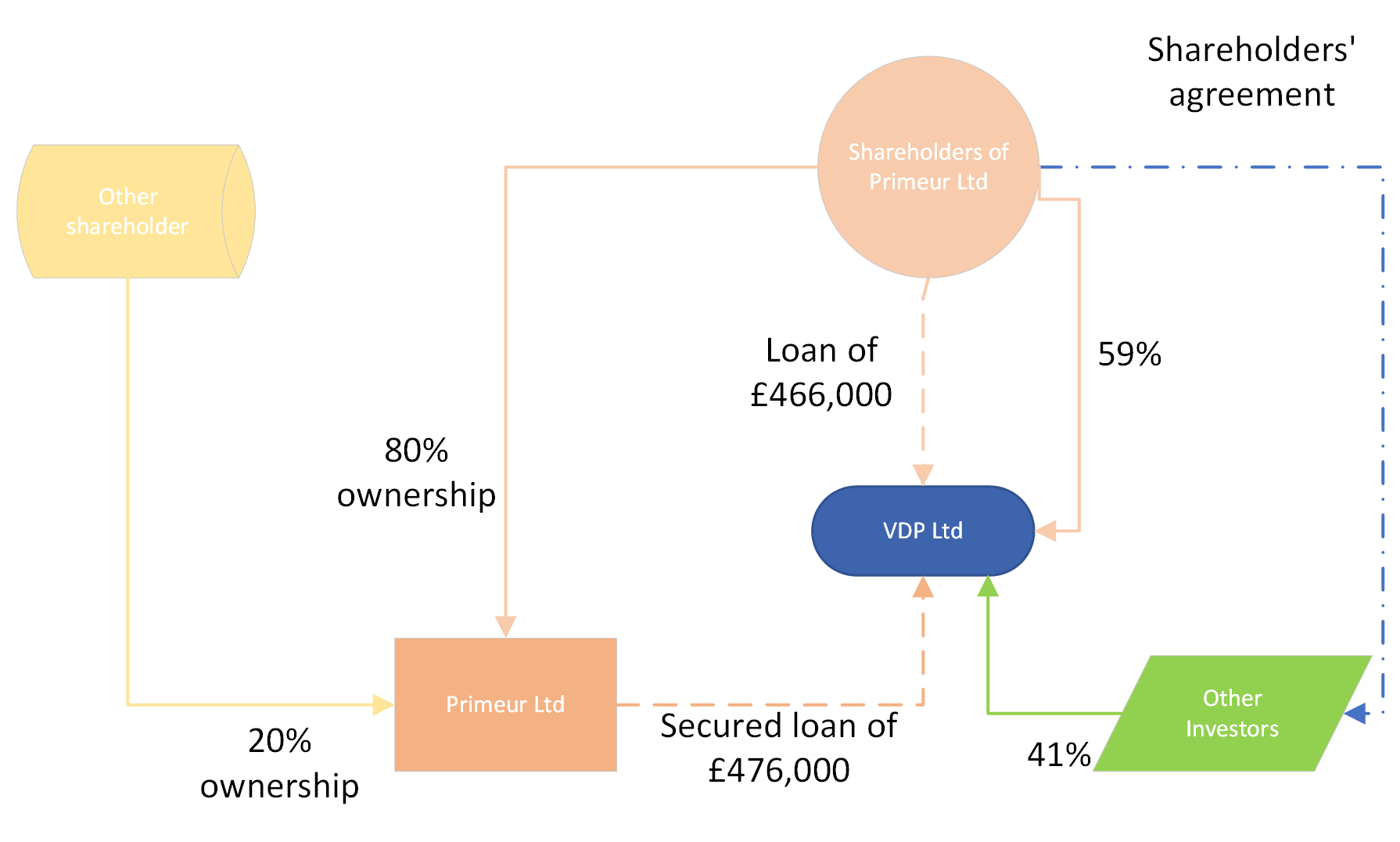
The Company lent money to VDP. The shareholders of the company also made loans to VDP personally. The diagram below shoes the scenario: Two shareholders owned the majority of Primeur Ltd - another investor had been given 20% of the voting shares (there were other ‘deferred’ shares in issue, but these had no voting rights). These two majority shareholders in Primeur Ltd also held 59% of VDP - which suggested they controlled both companies together. Other shareholders held the remaining 41% of VDP's shares. There was a shareholders’ agreement between the shareholders of Primeur Ltd which meant certain actions could not be taken by the two 80% shareholders.
Connected?
HMRC argued the companies were connected; they said that the majority of shareholders in the company were also able to secure the affairs of VDP and therefore they were connected for loan relationship purposes. The effect of this would make any debits on an inter-company write off tax-neutral. At face value, one can see why HMRC made this argument. The two shareholders in Primeur held 80% and also had 59% of VDP. In normal circumstances, this would enable them to control both companies for loan relationship purposes.
However, when looking at whether companies are connected for loan relationship purposes, it is crucial to consider ‘other documents’ which may impact on the exercise of control. It is common ground that a shareholders’ agreement is one such document. The agreement in the present case meant that control was not the same between the Company and VDP. The following rights required approval from the minority shareholder in Primeur Ltd, and this was considered to be fundamental to the control of the company:
- Changing the constitution.
- Changing the company name.
- Issuing debt instruments.
- Forming subsidiaries.
- Merging, or winding up the business.
- Changing the nature of the business carried on by the company.
- Making loans.
- Permitting transactions with associated companies or shareholders.
As the two 80% shareholders could not exercise these fundamental rights over Primeur Ltd, the Tribunal held it was not connected with VDP. The result of this was that at face value, writing off the loan gave rise to a taxable credit in VDP (which was released from its obligations) and an allowable debit in Primeur for releasing its right to receive repayment.
Unallowable Purpose
The unallowable purpose legislation can do all manner of things to prevent manipulation of loan relationship debits and credits: It can stop debits being larger or credits smaller, prevent clever timing tricks and all sorts. The rule bites where something is done which has no business or commercial purpose, or if there is a tax-avoidance motive.
It can also apply to ‘related transactions’ and not just the actual making of loans. These related transactions catch writing off loans as a distinct element potentially subject to the rule. It is therefore irrelevant whether the loan initially had a commercial or business purpose (i.e., putting excess funds to good use and getting a return) if the write-off doesn’t also have a business or commercial purpose.
Here, the loan from Primeur to VDP was secured. The loans which had been made by the shareholders were not. Therefore, in writing off its loan, Primeur had decided not to enforce its security and instead allowed VDP to repay the two 80% shareholders of Primeur in full. This was held not to be within the ‘commercial or business interests’ of Primeur.
On the evidence available, the decision to write off the loan meant that Primeur suffered financially (potentially being out of pocket in the amount of nearly £200,000) whilst its shareholders benefitted. The Tribunal didn’t go so far as to say the security was the reason why the write-off was for an unallowable purpose. But it intimated that should the Company have so wished, it could have secured full repayment of its secured liability, and also received a partial repayment of its unsecured balance it was also owed.
If none of the loans were secured, I still think the Tribunal would have concluded that the partial write-off was outside the commercial or business purposes of the Company; the only reason for doing it was to ensure the shareholders received their repayments in full.
Discovery
Having found that there was an unallowable purpose, the FTT was again tasked to consider the behaviour that led to the error. If this was a mistake despite taking reasonable care then HMRC would not be able to assess the tax as they would have been out of time.
The company had taken advice from Grant Thornton, their advisers. Normally, taking advice will demonstrate that reasonable care has been taken by the company and this was indeed what they argued. The Tribunal agreed that the Company had taken reasonable care. Even though the report prepared by Grant Thornton was addressed to VDP, the tribunal said it was normal in inter-group transactions for advice to be written for one party, but knowing that the entire group (or at least the parties to the transaction) were going to rely on it. They found this, despite the existence of reliance restrictions in the document.
However, the Tribunal went on to say that they did not believe Grant Thornton took reasonable care and they were therefore careless. This is crucial, because whilst it is only the behaviour of the company which is relevant for penalties, for discovery assessments and the related time limits, HMRC can look at the behaviour of advisers acting on behalf of the company.
This is a long, but useful quote from the Tribunal:
”…it is our view that when loans are being written off the unallowable purpose provisions are a matter of fundamental importance to any advice regarding the propriety and technical basis for asserting that a partial write-off of a loan could be taken as a tax-deductible debit in the accounts and tax return of the lender. The unallowable purpose provisions are renowned for having an extensive but somewhat undefined scope and thus impact on both the creation of a loan relationship and matters affecting it. So, we do not think that the submission that the justification for failing to address the unallowable purpose in the GT report as its being irrelevant, has merit. We would have expected that unallowable purpose would have been addressed in the report if only to reject its application to the circumstances. If this had been the case, and depending on the rationale given for that dismissal, it is much more likely that we would have found that GT had taken reasonable care in compiling the report. However no mention whatsoever is made in the GT report about unallowable purpose.”
Takeaways on loan relationships and giving advice
The unallowable purpose rules are clearly wide in their remit and anyone advising on corporate debt must consider them, and especially so in cases where it is expected that tax deductible debits will arise on a loan write-off.
The connected rules are also more nuanced than many appreciate. It is therefore important to understand the control structure of companies to make sure advice in this area is correct.
However, the one thing worse than giving incorrect advice, it seems, is ignoring the issues altogether! The Tribunal said that had Grant Thornton commented on the unallowable purpose rules but considered them not in point, then it may have come to a different conclusion. Of course, giving completely incorrect advice would not hold up: If the advice is so clearly wrong that a competent business owner should have known better, it may not save them. However, in many cases taking proper advice which has been carefully prepared, even where that advice later turns out to be incorrect, can save clients from penalties and extended assessing time limits. This is one of the reasons why when a course of action is uncertain from a tax perspective, obtaining proper advice can protect the taxpayer in question from extended assessing time limits and penalties.
Wholly and exclusively for the purpose of the trade
Where a company takes a deduction for expenses incurred, it is for the company to show the deductions are made wholly and exclusively for the purpose of the trade. In this case, the appellant took £11,630 of petty of cash and claimed it was all wholly and exclusively for the purpose of the trade. HMRC argued that there had not been sufficient evidence to accept the expenses and disallowed 70% of the expenditure as being non-business related. HMRC also said the error arose because of careless behaviour.
HMRC said there was absolutely no evidence for the expenditure, but the Tribunal disagreed; there was no documentary evidence, but they could accept the verbal evidence of Mr Keighley. He stated that the cash was used exclusively on business trips to India and Sri Lanka for himself and employees and only in relation to business costs. The Tribunal accepted this in part, but said that some element of the expenditure would have had a non-business purpose and they quantified this at 20%. They therefore allowed 80% of the petty cash expenditure. They also agreed that the behaviour related to the error was ‘careless’, because no verification was attempted by the appellant to try to get it right.
Takeaways
HMRC will often push back on verbal evidence. There is no doubt: it is far better to rely on contemporaneous documentary evidence instead of verbal evidence. However, where a witness provides verbal statements, these are often dismissed by HMRC. Even so, in many cases they are given weight by the Tribunal and so ensuring that the facts are presented to HMRC in the right way can be important.
Summary
This case included a lot of issues. As a reminder, the result was not a great one for the two appellants, Mr Keighley and Primeur Ltd.
On the additional remuneration issue, the appellant lost in full and the discovery and penalty assessments stood as originally made. The company had to pay the national insurance, but won against the £22,125 penalty because the company had not been deliberate. This was to be recalculated as a careless penalty which may provide a significant saving on that penalty and potentially allow suspension conditions to be agreed to mean it never needs to be paid.
On the loan relationship points, the companies were not connected, but the loan relationship debit arose due to an ‘unallowable purpose’. No penalties were charged; the company had taken reasonable care by getting advice from their agent. However, because Grant Thornton were careless in giving this advice (by not considering all the relevant issues), that carelessness extended the assessing time limits on the Company. The behaviour of the agent cannot be relied upon for penalty assessments and so they were set aside.
Finally, considering the petty cash issue, the Tribunal revised the amount of allowable expenditure upwards from 30% to 80% on the basis of the appellant’s verbal statements, but upheld careless penalties.
Comment
On the whole, I think the Company will be disappointed with the decision, but it isn’t surprising to advisers familiar with these areas. HMRC will expect business owners to know that where a company pays for something on their behalf, tax will be due. Turning a blind eye to this can lead to deliberate penalties and the associated 20-year assessing time limits. As advisers, it is important to ensure clients give the proper attention to the tax returns they are sent, and understand that thinking they got away with something because an adviser missed it doesn’t get them off the hook! Remember, in this case HMRC were able to assess tax going back to 2001 due to the deliberate behaviour - interest will also have run from the original due date on these amounts!
For loan relationships, I’ve said this over and over again: The unallowable purpose rules will create lots of problems for a variety of companies. Here though, the most important point for advisers is making sure they are competent to advise on whatever it is they are providing advice for. If they aren’t, they risk doing their clients’ a disservice and extending HMRC’s assessing time limits by not commenting on a relevant issue. Where a sensible conclusion is drawn, even where it may end up being incorrect, it could go a long way to preventing the extended assessing time limits and penalties.
Finally, remember that whilst HMRC rarely puts much stead in verbal evidence, that doesn’t mean a Tribunal won’t. Hearing the statement of a credible witness can sway the outcome of proceedings as it did here. Whilst the petty cash issue was relatively low value compared to some of the other issues here, the principle it highlights stands.
Next week
The next issue will explore tax efficient remuneration packages for owner managers of companies, with a focus on some of the lesser used allowances.
Remember - if you are a paying member of Taxing Thoughts you can request analysis by emailing requests@taxingthoughts.co.uk
Member discussion